

Key Takeaways
- Signage guides guests between key wedding zones.
- Signs should appear where guests make decisions.
- Different sign types solve different practical needs.
- Stability, lighting, scale, and venue conditions matter.
- Good signage should complement the décor and support a visually cohesive guest experience.
Introduction
Singapore weddings often move guests through several areas within the same venue. Guests may register, enter a solemnisation area, move to dining, then visit a photo zone. We approach wedding signage ideas as part of that journey, keeping transitions clear and the venue cohesive.
A coordinated wedding setup gives every sign a purpose. Some confirm the correct event or function space; others explain where to sit or go next. When signage follows guest movement, organisers spend less time repeating directions.
Why Signage Is Essential in Wedding Environments
Before selecting colours or materials, we identify where guests need reassurance, information, or direction. This keeps each sign useful when guests need to make a decision.
Supporting Guest Navigation
The strongest wedding signage ideas answer questions before guests ask them. Welcome signs confirm the event, arrows clarify routes, and table information supports seating. In larger or multi-room venues, these touchpoints make unfamiliar spaces easier to understand.
Reducing Reliance on Manual Guidance
Without clear signs, ushers may repeatedly give the same directions. A thoughtful setup using custom wedding signage reduces that dependence. Staff can focus on registration, timing, coordination, and guests needing personal help while signage handles predictable questions.
Common Types of Wedding Signage
We match each sign’s message, size, and location to the decision a guest needs to make.
Welcome Signage
A welcome sign creates an obvious arrival marker. It can show names, the wedding date, or reception details while confirming the correct function space. Its design can also introduce the visual language used throughout the venue.
Seating Charts
Seating charts organise table assignments before guests enter dining areas. They should be easy to scan and positioned with room for people to stop. For larger lists, clear ordering can reduce searching and crowding near ballroom doors.
Directional Signs
Directional signs connect ceremony areas, reception desks, dining rooms, restrooms, and photo zones. Effective event signage, when planned for weddings, uses concise wording, clear arrows, and consistent styling so guests recognise each piece as part of one wayfinding system.
Photo Backdrop Signage
Photo-zone signs identify the photography area while adding character. The sign should work with the event backdrop rather than compete with florals, props, lighting, or the couple and guests being photographed. We consider framing, viewing distance, and queue space before recommending scale and placement.
Feature Signage
Feature pieces create focal points at stages, entrances, or photo areas. Custom neon signs can display names, initials, phrases, or motifs. The best wedding signage ideas account for sightlines, photography angles, power access, and nearby décor, so visual impact does not compromise use.
How Signage Is Integrated into Event Layouts
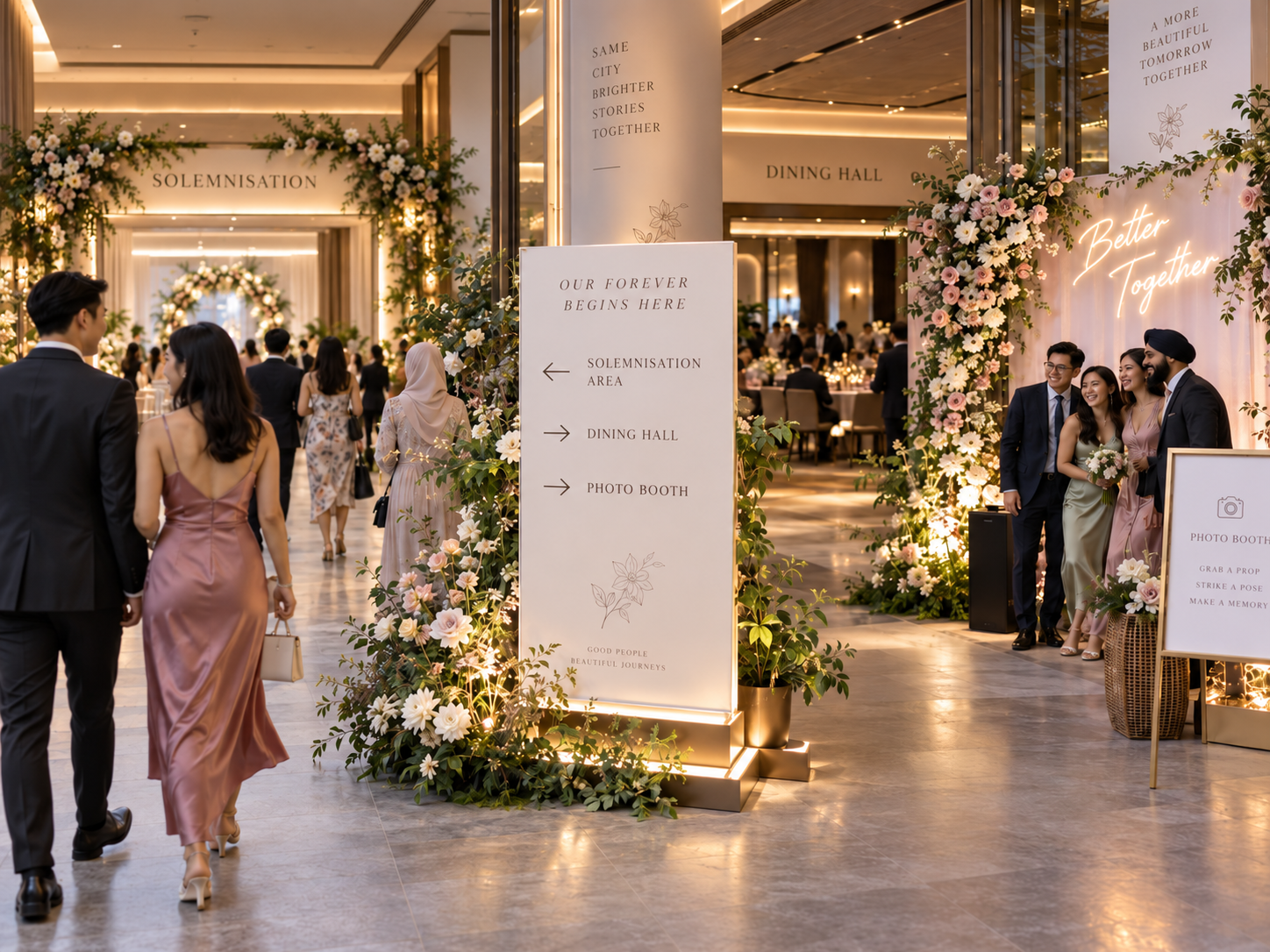
We plan signage alongside entrances, walking routes, furniture, programme stages, and guest sightlines. This prevents important information from becoming an afterthought once styling and equipment occupy the space.
Placement at Entrances and Transition Points
Decision points deserve priority. Guests need information when they enter, leave a lift lobby, reach a corridor junction, or move from ceremony to dining. We place each cue close to the decision so the next step feels obvious rather than forcing guests to search.
Alignment with Venue Flow
Good wedding signage ideas work with natural walking paths. We consider where people will look and whether flowers, partitions, doors, or equipment could block visibility. This matters in compact Singapore venues, where signs must remain noticeable without taking over circulation space.
Supporting Programme Movement
Wedding programmes rely on coordinated transitions. Signage can guide guests from registration to ceremony, then towards refreshments or dining without repeated announcements. It does not replace ushers, but gives everyone a consistent visual reference when several activities happen nearby.
Practical Considerations for Wedding Signage Setup
A sign can look excellent on screen yet underperform on site. We review installation conditions, visibility, and space as carefully as typography, colour, and finish.
Stability and Installation
Freestanding signs need stable bases and appropriate mounting, especially near entrances or busy walkways. Floor conditions, traffic, cables, and accidental contact should be considered during setup. Signage and backdrops should also be positioned with clear evacuation routes in mind so they do not interfere with safe movement through the venue.
Lighting Conditions
Lighting changes throughout a wedding. A sign that reads well in daylight may disappear under dim ballroom lighting, while reflective materials can create glare. We check contrast, illumination, viewing distance, and photography needs so information remains readable.
Space Limitations
Compact venues reward disciplined sizing. Oversized signage can narrow circulation, while undersized pieces are easily missed. We balance visibility with available floor space and décor. Where space is limited, wall-mounted pieces, shared sign stations, or a photo booth backdrop can create impact without obstructing movement.
How Signage Improves Guest Experience
Guests rarely notice good wayfinding as a system. They simply feel that the event is easy to understand, which creates a more comfortable experience from arrival onward.
Reducing Confusion
Clear signs remove small uncertainties, from finding registration to locating a table or photo area. Well-planned wedding signage ideas can help guests make simple decisions independently, helping them feel comfortable in an unfamiliar venue and reducing interruptions for organisers.
Supporting Smooth Transitions
Transitions create pressure because many people may move at once. Clear cues show the next destination before a crowd forms. Guests spend less time stopping in doorways or asking where to go, giving coordinators better control over programme timing.
Maintaining Event Flow
When guests navigate confidently, the programme can progress with fewer interruptions. Signage keeps information consistent across spaces and supports the intended journey. It also helps venue teams, planners, vendors, and hosts work around the same movement plan.
Conclusion
At Sui Generis Signage, we fabricate custom signage in-house in Singapore and plan each piece around venue conditions, visual priorities, and guest movement. We can help you decide what needs a sign, where it should sit, how it should be installed, and how the system can stay cohesive without sacrificing clarity.
Speak to us about a wedding signage setup that fits your venue and event flow.