

Key Takeaways
- Clear instructions help customers understand where to start, what to prepare, and what happens next.
- Good signage reduces hesitation, confusion, and avoidable mistakes before customers reach the service counter.
- Entrances, queue starting points, and counter areas each need guidance suited to the decisions customers make there.
- Different signage formats can be used depending on whether information stays fixed or needs to change regularly.
- Better guidance reduces repeated explanations and helps staff maintain a smoother, more organised service flow.
Introduction
Before customers reach your counter, they are already interpreting your space. They decide where to enter, whether to queue, and what happens next. When those answers are visible early, customer expectations become easier to manage. We treat signage as part of the service journey because clear instructions remove uncertainty before staff intervene.
In Singapore’s retail, F&B, clinic, office, and customer-service environments, early guidance matters. Effective service instruction signage gives people the right information at the right moment in a form they can understand quickly.
Why Customers Need Clear Guidance Before Engagement
Customers should not learn your process by watching someone ahead. We plan guidance around their first questions: Where do I begin? Do I take a number? What should I prepare? Clear answers set customer expectations before staff involvement and make unfamiliar environments easier to navigate.
Reducing Hesitation
Hesitation appears at decision points. A customer slows at an entrance, stops beside a queue barrier, or scans for clues. Well-positioned instructions remove that pause. Keep the message short and make the next step obvious.
For fixed instructions such as “Registration Here”, “Collection Point”, or “Prepare Your Order Number”, sign boards give customers a durable reference exactly where they need to act. Because these messages may remain in place through daily use, we also consider material choice and fabrication quality during our in-house production process.
Preventing Incorrect Actions
Customers who join the wrong queue or reach the counter unprepared need earlier information. Clear signage provides the customer guidance needed to prevent missed registration steps, incorrect queueing, or premature approaches to staff.
How Signage Defines Service Steps Clearly
A service journey becomes easier when customers can see its sequence. We map each message to an action rather than decoration. This helps customers follow the service sequence independently while giving your team a consistent way to communicate customer expectations during busy periods.
Step-by-Step Instructions
Good instructions follow the order in which decisions happen. Start here. Prepare this. Wait there. Proceed when called. Each message should answer one immediate question. Numbering, icons, and consistent wording make multi-step processes easier to scan while customers move.
Preparing Customers Before Interaction
The final approach should confirm readiness. If customers need an appointment confirmation, order number, identification, payment method, or form, say so before they reach staff. This is where signage can provide useful guidance for each stage of the service process: waiting time becomes preparation time, reducing back-and-forth.
Types of Instructional Signage Used in Service Environments
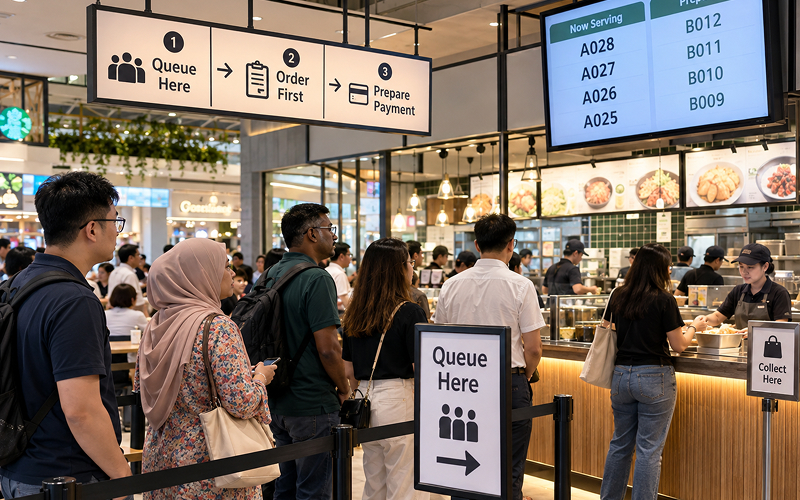
Different moments call for different formats. A short, fixed instruction viewed at close range may only need a static display. Longer instructions need enough space to be scanned comfortably, while information that changes throughout the day is better suited to digital screens.
In visually busy areas or at longer viewing distances, stronger contrast or illumination becomes more important.
For higher visibility, lightbox signage can help a fixed message stand out where competing visuals make ordinary displays easier to miss.
Directional Guidance
Directional signs answer a basic question: where should you go? They identify entrances, registration points, collection zones, counters, or queue starts. Arrows should be unambiguous, labels should match staff terminology, and signs should appear before a turn.
Process Instructions
Process signs explain what customers must do once they arrive. Keep sequences compact and prioritise actions over explanation. If five steps are necessary, show five. If two are enough, stop at two. The best instruction is one that customers can understand and act on immediately.
Digital Updates Where Needed
Digital displays suit information that changes frequently, such as queue numbers, counter availability, collection status, or waiting stages. They should complement permanent wayfinding. Keep fixed instructions stable and use screens for live information so customers can distinguish the process from its status.
Where to Place Signage for Maximum Clarity
Placement should follow the customer’s decisions from the entrance to the queue, waiting area, and counter. We walk through the space from a visitor’s perspective and identify uncertainty. This helps shape customer expectations by giving people the right instruction before they make a choice, rather than after a wrong turn.
Singapore’s LTA applies a similar principle through its street-level wayfinding system, where signs are strategically positioned and familiar icons help people identify destinations and navigate more easily.
Entrances
Entrance signage should establish the first action quickly. Tell customers whether to register, take a queue number, proceed to a zone, or prepare something before joining the line. Avoid secondary policies here. Orientation matters more than detail.
Queue Starting Points
Queue entries need reinforcement because customers are committing to a path. State who the queue is for, what to prepare, and whether another step comes first. If services share one area, differentiate them clearly so customers do not wait in the wrong line.
Near Service Counters
Near-counter signs act as a final checkpoint. Use short reminders: have your order number ready, prepare payment, or wait until called. They should not introduce a new process. If customers learn something essential only at the counter, earlier guidance needs attention.
How Clear Instructions Improve Operational Efficiency
Better guidance reduces avoidable questions, corrections, and stop-start movement. We consider both the customer journey and staff workflow. A capable signage company should understand where communication problems become operational problems, then design around those points instead of filling wall space.
Reducing Repeated Explanations
Staff should not spend every interaction repeating instructions communicated earlier. When signs answer predictable questions, employees can focus on exceptions, complex requests, and the service itself. During peak periods, repeated explanations can slow the counter.
Supporting Smoother Service Flow
A predictable flow means less cross-traffic, backtracking, and uncertainty. It also gives teams a consistent rhythm. Clear instructions cannot solve every queue problem, but they can remove preventable friction. When customer expectations match the actual process, people arrive knowing what is required.
Conclusion
Walk your service journey as a first-time customer and mark every point where you would stop, ask, guess, or turn back. Those moments are where clearer signage can make the biggest difference.
At Sui Generis Signage, we help businesses identify key customer decision points, choose suitable signage formats, and develop signs around the way customers actually move through a space. With in-house fabrication in Singapore, we can support signage that fits your service flow, viewing conditions, space, and operational requirements.
Speak with our team to review your customer journey and identify the signage formats, placements, and instructions that fit your service environment.