

Key Takeaways
- Modern signage must work operationally, not just visually.
- Durability, maintenance and updateability matter beyond first-day appearance.
- Modular and hybrid systems support changing spaces, tenants and campaigns.
- Singapore’s climate, regulations, movement and installation conditions should guide early decisions.
Introduction
Modern signage should be planned as part of a space from the outset because it affects visibility, navigation, installation and maintenance. The strongest design trends come from questions: Who needs to read this? From where? How often will the message change? What happens when the space gets busy?
In Singapore, those questions matter because environments move quickly and signage must perform reliably beyond opening day.
Why Functionality Is Driving Modern Signage Design
For us, good signage begins with a clear operational purpose. This purpose may involve identifying a storefront, directing visitors, presenting a tenant directory or communicating information at the point of decision.
Shift from Purely Visual Design
Brand expression still matters, but visual impact cannot rescue a sign that is difficult to read or poorly positioned. Design trends favour hierarchy, contrast and disciplined content. We test what viewers notice first and whether branding remains recognisable without competing with the message.
That matters when planning signage design carefully, particularly for commercial spaces where signs coexist with architecture, lighting and moving people.
Focus on Usability and Performance
We look at viewing distance, sightlines, light and traffic before choosing scale or illumination. A reception sign may be read slowly at close range. A directional sign near a lift lobby must work faster. The right specification depends on the setting, not fashion.
Cost Efficiency and Long-Term Maintenance Considerations
A lower installation price does not always produce the lower cost. We encourage you to consider cleaning, access, replacement parts and expected service life before approving a specification.
Material Durability
Material choice should reflect contact, moisture, sunlight and cleaning frequency. Modern signage solutions use materials and finishes for specific conditions rather than one method everywhere. Aluminium signage can be a practical choice where low weight, corrosion resistance and a clean finish are priorities, but construction must still suit its fixing method, location and exposure.
Ease of Upkeep and Replacement
Another shift in design trends is greater attention to maintenance, with signage increasingly designed for easier servicing and future updates. We prefer systems where serviceable elements are accessible without dismantling an entire feature. Replaceable faces, removable covers and planned cable access can simplify repairs or updates.
That matters above an active shopfront or inside a working office where disruptive work is difficult to schedule.
Modular and Adaptable Signage Systems
Businesses change. Teams move, tenants rotate, campaigns end, and spaces get reconfigured. Signage should respond without forcing you back to a blank sheet every time.
Flexible Layouts
Modular systems can separate permanent structure from parts likely to change. In an office directory, the mounting system may remain while names or room allocations change. In retail, a fabric light box can support replaceable graphics while retaining the frame and lighting system.
Updating Content Without Full Replacement
This is where business signage requirements need to cover more than appearance, including update frequency, replacement needs and long-term use. We ask which information is fixed, which may change monthly, and which could change tomorrow. Interchangeable panels or graphic layers keep updates focused on the changed component, helping you avoid unnecessary fabrication and removal.
Integration of Digital and Static Signage
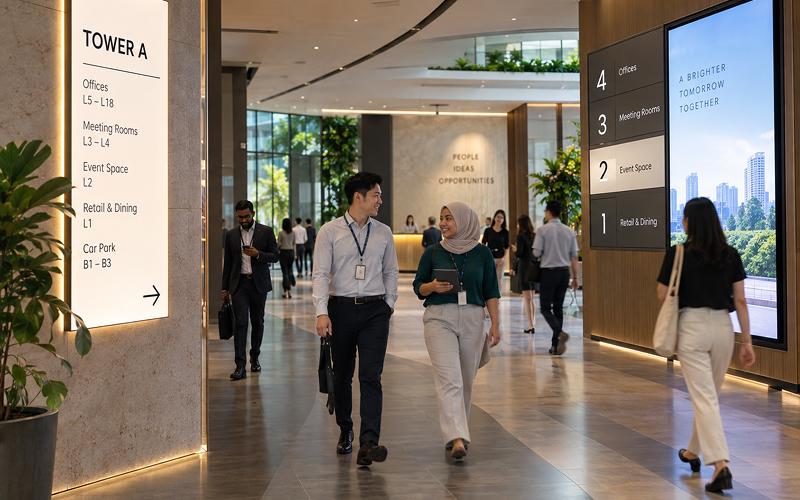
Not every message needs a screen, and not every message should be permanent. The better question is which information benefits from frequent updates and which should remain stable.
Hybrid Signage Systems
Hybrid setups combine permanent brand markers with dynamic content. You might use a fabricated identity sign for recognition and a screen for promotions, queue information or event schedules.
For temporary launches, event campaigns, seasonal promotions or trial activations, LED display rental can provide flexibility without committing the site to a permanent screen before its long-term value is clear.
Updating Information Without Physical Changes
Digital content can be revised without reproducing a panel, but that flexibility brings operating needs. Power, connectivity, content ownership, brightness, maintenance access and fallback messaging require planning. We see digital signage as part of a system, not a substitute for clear static communication.
Influence of Environment and Climate on Design Choices
Singapore conditions make material and construction decisions particularly important. Heat, humidity, rainfall and daylight can expose weak specifications quickly, especially outdoors.
Indoor vs. Outdoor Requirements
Indoor signs allow more control over lighting and weather. Outdoor signs need more attention to sealing, drainage, fixings, finishes and electrical protection.
For sites outside the Central Area, reviewing URA’s guidelines for outdoor signs early can help you account for requirements relating to sign placement, size, height and form before the design progresses too far.
Durability in Singapore Conditions
In practice, design trends for climate-exposed signage are less about choosing one “weatherproof” material and more about considering the complete assembly. Edges, joints, coatings, fixings and ventilation influence how a sign ages.
We consider water exposure, heat around lighting and future maintenance access so material selection, component placement and servicing requirements can be planned into the signage build from the outset.
How Operational Needs Shape Signage Decisions
The best sign is not only legible. It works with the way your site operates, from customer flow to delivery access and installation windows.
Customer Movement
We study where people arrive, pause, queue and make decisions. A sign where customers naturally look can reduce hesitation without adding messages.
This is why design trends increasingly emphasise wayfinding that responds to movement patterns, rather than treating every wall as communication space.
Space Constraints
Compact sites demand restraint. Oversized signage can narrow sightlines, compete with merchandise or make a small frontage feel cluttered. We balance prominence with proportion so signage earns attention without overwhelming the architecture or interfering with circulation.
Installation Practicality
Installation planning should begin before fabrication. Access equipment, ceiling conditions, power points, landlord restrictions and working hours influence what is practical.
Our in-house fabrication in Singapore helps us coordinate production and installation directly, while quick quotations support time-sensitive planning. Warranty support also gives you a clear route for addressing issues after installation.
Conclusion
At Sui Generis Signage, we believe your signage should be planned around how your space actually operates, including visibility, maintenance, installation and future updates. With the right approach, you can create signage that remains practical, adaptable and effective over time.
Speak to us about your signage requirements.